Below is an excerpt from the Article in the September 2008
AMERICAN ARTIST MAGAZINE
Also, below that is Ian Factor's interview in its entirety.

• • •

Timeless Personalities
Captured by Contemporary Portraitists

by Allison Malafronte
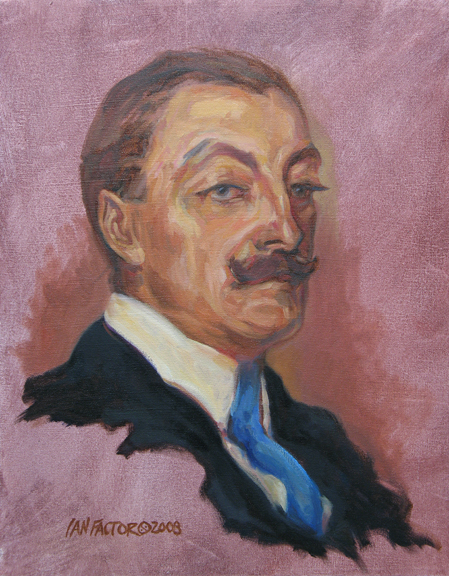


John Drew • 20" x 16" • Oil on Canvas •
Collection of The Players Club, NYC • ©Ian Factor 2008
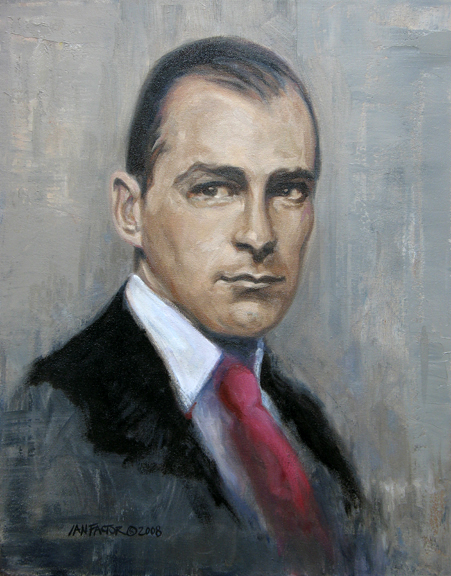


George Abbott • 20" x 16" • Oil on Canvas •
Collection of The Players Club, NYC • ©Ian Factor 2008


• • •

Eighteen artists were recently given the honor of paint-
ing members of the famous Players Club, in New York
City, for their newly organized Hall of Fame. Those works
now hang among the club’s impressive collection of por-
traits, including those by John Singer Sargent, Norman
Rockwell, Gilbert Stuart, and Everett Raymond Kinstler.

IF THE WALLS OF THE HISTORIC Players Club
in Gramercy Park could talk, we would likely overhear
some of the most intriguing and colorful conversations
in New York society history. For it was here, in 1888,
that the preeminent Shakespearean actor Edwin Booth
dedicated this three-story townhouse to the theatrical
leaders of the day, offering them an environment to
connect with other prodigious talents in the arts, letters,
and commerce. And it has been here that some of the
most celebrated actors, playwrights, poets, and painters
have gathered to share the camaraderie and convivial
spirit that has made this club one of the most venerable
organizations in the American arts.

If we were indeed privy to the dialogue that took
place within the walls of 16 Gramercy Park South,
certainly one of the first discussions we would hear
would be between Booth and his good friend
Stanford White, the famed New York City architect
who Booth hired to convert the townhouse into a
classic yet comfortable clubhouse. Perhaps the next
conversation would be between Booth and co-founder
Mark Twain as they conferred over the direction they
saw the club headed and who would be granted
membership. Then, over the next several decades, we’d
likely be privy to lectures, toasts, roasts, and ruminations
from such illustrious members as Ernest
Hemingway, Eugene O’Neil, John Barrymore, and
Frank Sinatra, as they raised a martini in The Grill To
celebrate a Nobel Prize; honored a fellow member for
his successful screenplay in The Sargent Room; or gath-
ered around the grand piano in The Great Hall to sing
the latest show tune or aria.

Thankfully, we don’t have to rely on brick and mortar to
record the storied legacy of The Players Club. Premier por-
traitist Everett Raymond Kinstler, a member of the club
since 1970 and the art committee chairman, recently
organized The Players Club Hall of Fame, a project for
which he selected 18 artists from around the country to
paint portraits of 27 members of the club, both past and present.
Permanently displayed among the impressive collection
of portraits by such artistic greats as John Singer Sargent,
Norman Rockwell, and Gilbert Stuart, these 27 portraits offer
contemporary interpretations of the timeless personalities that
are recognizable to millions of Americans.

Once Kinstler had selected the artists he wanted to partici-
pate in The Players Club Hall of Fame—all of whom he says
were chosen as portraitists he both respected as painters and
valued as friends—he assigned a subject to each that he
thought best matched his or her personality and artistic style.

“There were no restrictions on the artist’s interpretations,”
Kinstler explains. “They we’re given total freedom, except that
the portrait had to be 20” x 16”, no works could be under
glass, and the framing had to be modest” The 18 artists who
participated in the project were: Basil Baylin, Loryn Brazier,
Mac Conner, Peter Cox, Tom Donahue, Ian Factor, Irene Hecht, Ed Jonas,
Everett Raymond Kinstler, Holly Metzger,
Michael Shane Neal, David Beynon Pena, John Reily, Linda
Kyser Smith, Johanna Spinks, Dot Svendson, Gordon
Wetmore, and Dawn Whitelaw.

• • •

Interview with Ian Factor for above article in its entirety:

1.) What were the guidelines/rules you were given for this project?

The only guidelines were that the portrait be 20 x 16 inches and not done
on any surface needing to be framed under glass.

2.) How did you approach the portrait? Did you know a lot about your subject
beforehand, or did you have to research that person's life and history?

I knew little about John Drew, and basically nothing about George Abbott
when I started the project. The research I did for the portraits was
extensive, turning up only limited images of John Drew, most of which were
old retouched photos with very questionable information, and only one decent
photo of George Abbott when he wasn´t in his 90s. I met with the director
of the Library at the Players for further images and he had none of Abbott
and only a handful of Drew. The biggest help for the Drew Portrait was the
Portrait of him done by James Montgomery Flagg hanging in the Players Club.
This gave me most of the information and characterizations
I would use for the final piece.

3.) For those of you who worked on deceased artists, what did you use as
reference for the physical appearance of your subject? Did you find it
difficult to capture the personality of a subject you could not paint from
life or interview in person? For those whose subject is still alive, did you
work from life or photographs, and did you interview the subject as well?

Both of my subjects are deceased.
The image I used for the George Abbott Painting, was the only photo
I found of him as a younger man. It was a very small B/W photo
of bad quality. It was a tough translation, especially not knowing his
personality or character at all.
The Drew painting was done combining a few poor quality BW photos of him
I found in the Players Club Library, and of course the Brilliant Portrait of him
by Flagg Hanging at the club.

4.) Did you know much about The Players club and its distinguished history
before this project? What are your feelings on having your work hanging near
some of the greatest portrait painters in history?

I knew quite a bit about the club from many conversations with Ray Kinstler,
and lots of trips to the club with him. I just moved into a studio right across
Gramercy Park from the club, so I have the amazing fortune to be very close.
I have also just been asked by Ray to serve on the Art Committee of the Club.
The opportunity to have my work hanging there is indescribable. I am
beyond honored to be part of that collection and to have my portraits
hanging with some of the greatest portrait paintings in history.
It is actually surreal when I stop and think about it.

5.) What was your favorite part about this project? What did you learn about
yourself as a portrait painter, your subject, and/or the history of the club?

My favorite part was actually the night of the unveiling. The feelings and energy
were so strong, the event was wonderful and so very meaningful, and to
be close with so many incredible artists, painters, actors, musicians all
there to celebrate and appreciate the portraits was really one of the most
magical and memorable events of my life. Absolutely beyond words.
Also, to learn more about the history of the club, the artwork within its walls,
and the people involved has been a thrill and an honor.

I learned yet another level of patience when it comes to working from
poor quality reference shots, and once again the absolute importance of
working from life when possible. Without meeting the person face to face
and working from life for at least a study, the ability to project the
subject´s energy, character and subtle physicalities becomes so much
more difficult, the experience becoming removed from an actual
connection with another human being....the main reason I paint portraits.

6.) Please feel free to include any other information or commentary you would
like, and thank you for your time!

I would like to conclude by saying that I am forever and deeply indebted to my
dear friend Ray Kinstler for not only the opportunity to be a part of this most
important and historical event, but for the endless care, time and passion he has
invested into this project. Ray has been, since the day I met him
10 years ago, a mentor, a friend, an inspiration and a motivation with no equal.
There are not enough lines here to thank him for everything he has done for me
personally, for the Players Club, and for the history and
lineage of American Realist Painting.
One trip through the halls of the Players or the National Arts Club,
right next door, will give one an idea of how much he has contributed
and continues to contribute to this world.
Additionally, a huge thanks to Peggy Kinstler for everything she has done
for this project as well.


 figures  landscapes  exhibits  resume bio  journal  email  newsletter